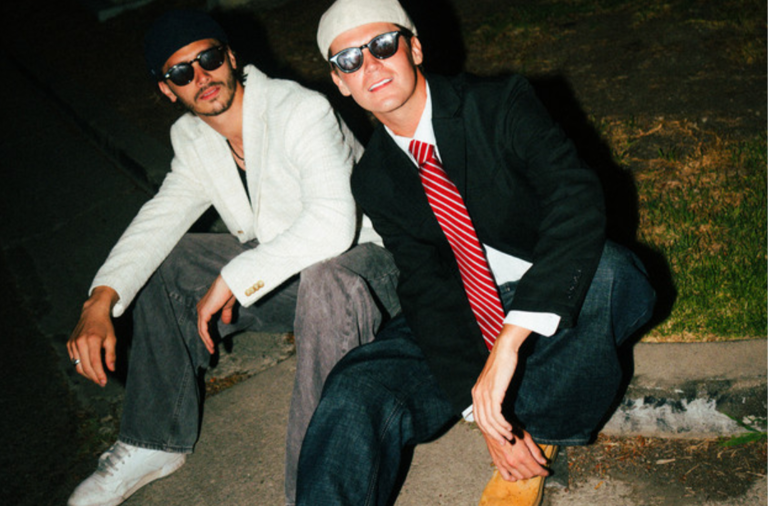
American rock band Dead Poet Society, not to be confused with the 80s film Dead Poets Society, has been around for over a decade. The four members met while attending the Berklee College of Music. Dead Poet Society consists of lead singer Jack Underkofler, guitarist Jack Collins, bassist Nick Taylor, and drummer Will Goodroad. On October 2nd, the band released their third studio album, Monarch, under Spinefarm Records.
Monarch opens with ‘Hollywood on Fire’. This forms the perfect opener to the album, as it starts with a high-pitched, haunting introduction sung by Underkofler. This lasts about half a minute before the drums and guitars kick in, truly beginning the album. It’s a dark track that builds really well and sets the tone for what’s to come. While most of this song is intense, there’s also room for some softer breaks in between, such as the bridge and outro. The lyrics, however, are definitely not soft, with Underkofler talking about dreaming of dying and stating that “there’s no better way to end it all”. This prepares the listener for the fact that ‘Monarch’ in its entirety is not a happy album. It’s an album that will discuss heavy themes, such as toxic relationships, addiction, and depression.
The darkness continues into ‘Roach’, the album’s second single, which was released back in June. This track starts with loud banging of the drums, quickly joined by a deep guitar riff. This song talks about a toxic, not necessarily romantic, relationship. Both participants are partaking in destructive behaviours such as smoking and drinking. The other person, who is called a “roach” by the singer repeatedly, is clearly bad for the singer, yet they keep leeching onto him, and he seems to keep letting them, despite recognizing this is not a good idea. This contrasts with the third song, ‘Die If You Don’t’. Here, the person Underkofler is talking to is all but a roach. Rather, this is a person he loves, who no longer seems to love him. Therefore, he’s asking them to let him down slowly, because he doesn’t wish to be without them: “I’ll die if you don’t need me anymore”. This track includes a unique-sounding intro, some funky tunes towards the third chorus, and slow, deep vocals that embody the pain he’s going through as a result of this break-up.
As stated earlier, (toxic) relationships are a returning theme throughout this album. The first single that was released for this album, ‘Sinner Systems’, is another track about this, although in this case, the relationship seems to be more lust than love. In this addictive song, Underkofler sings about using sex as a way to numb the pain. He’s not making love to the other person, but consensually using them as a means to an end. Crudely, this song also talks about mental health, as the singer is clearly not doing well and trying to find a way to suppress this. The track is followed by ‘Lost’, which more vividly discusses his poor mental health. “While everybody finds their place, I’ll be here in outer space,” he sings in this slightly softer-sounding song. Later on, in ‘Dead on the Inside’, Underkofler speaks about another person in his life who’s also not doing well, letting the listener know that there’s “a void when [he] look[s] in their direction”. As stated in ‘Roach’, this is a relationship where both people show destructive behaviours, not wanting to let the other know their true struggles.
Between ‘Lost’ and ‘Dead on the Inside’, the songs ‘Cold’ (the album’s third single) and ‘Psalm 136’ appear. According to Goodroad, ‘Cold’ is about “recognizing that reality [of losing touch with your passions and who you really are to gain acceptance] and choosing to indulge in it anyway”. It’s a reflective track where the singer asks himself “how did I become so cold?”, wondering where it all went wrong, completed once more by deafening instrumentals that make the song a true banger and strong choice for a single. ‘Psalm 136’, on the other hand, is a song about the lies of religion, growing up and being taught to love God. The Psalm it refers to starts with the text “give thanks unto the Lord; for he is good: for his mercy endureth for ever”. The instrumentals here heavily overshadow the vocals, making it sound like Underkofler is trying to shout over something but can’t be heard. It makes the listener want to scream right along with him, especially when at the end he keeps repeating the words “can you hear me now?” right before the song fades out.
Ninth on the album is the fourth and final single, ‘Miami for the Weekend’. The song, which starts off with an immediately recognizable guitar riff, talks about a woman who the singer hates and loves at the same time. It’s a fun song that would be perfect to mosh to. Another heavier track, ‘Get Hot’, follows it. This track showcases more destructive behaviours, being unable to let things go and feeling anger. Then comes the album’s second-shortest track, ‘The Park’, in which the singer talks about seeing “him” in ‘The Park’: “Oh God!”. Later, he sings about not having left his room and not having eaten since he saw this person. While not immediately clear who the “him” in question is—maybe a real person, maybe God—it’s evident that Underkofler feels uncomfortable now that he’s faced him.
Finally, the album ends with its longest track, ‘The Art of Suffering’. This is also the album’s slowest, most vulnerable song. The strumming of the guitar underlines Underkofler’s vocals, singing about broken promises and the “pain and violence” in his head. In this song, suffering is seen as something that is beautiful, because without this pain, art cannot be made. It describes all the songs that have come before it, that have been born from anger and sadness, never happiness. Monarch simply isn’t a happy album and was never going to be. This is exactly what makes it possibly the best album Dead Poet Society has released so far. The album is cinematic, melodic, raw, and honest. Next year, Dead Poet Society will bring the music from Monarch to live stages across Europe and the United Kingdom. Make sure to catch the band on this tour, because surely these songs will sound even greater live.
Written by: Mandy Huibregtsen
Edited by: Shanna Henselmans