A great deal of time has passed since Harry Styles released Harry’s House, one of the defining pop albums of the past decade. What followed was a world tour that quickly achieved legendary status and became a generation-defining moment for many fans. Styles has always stood for uncompromising dedication to music – for grand gestures, emotional openness and a pop aesthetic that never settles for the predictable. Breaking records almost seems to happen incidentally along the way. That this path would eventually lead here comes as little surprise.
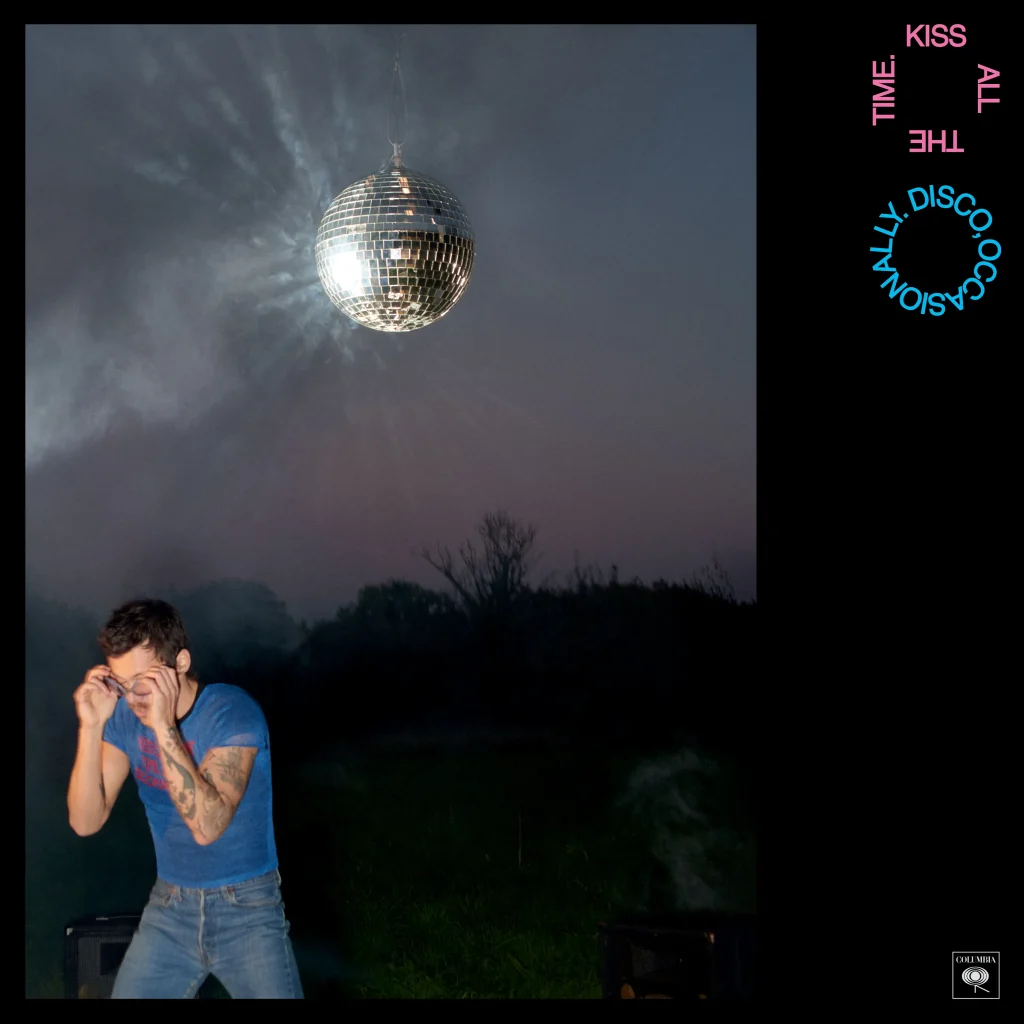
At just sixteen years old, Styles stepped into the spotlight as part of One Direction and conquered charts and fan hearts around the globe with the band. Since then, his career has seemed to move in only one direction – upward. What followed was a remarkable solo career, a life lived in the fast lane. Yet somewhere between all the glitter and glamour, feather boas and sold-out arenas, another thought quietly emerges: perhaps at some point people forgot to ask Harry Styles himself what he actually wants and what truly drives him beyond the spectacle. The answer arrives with Kiss All the Time. Disco, Occasionally (abbreviated as KATTDO).
Released on March 6th 2026, the album is the result of a period of withdrawal. However not into isolation, but back into life. Away from the constant noise of tours, headlines and expectations and toward the question of what Styles himself actually wants to express. Four years are a small eternity in the pop world and in that time expectations around him have grown to a level only a few artists ever experience.
During this period he largely withdrew from the public eye, travelling, running marathons and repeatedly appearing almost casually as an observer within the European club and concert scene. He himself has said that it was time to pause and shift his focus back to “other aspects of life,” perhaps even to “fall in love with music again.” In all its facets, but especially in those moments when music is truly experienced: when you feel it yourself, absorb it with your whole body and allow yourself to be carried away by it. Styles wanted to stand on the other side of the stage again. All these emotions, impressions and images find expression in his newest work.
When the first hints of a new album appeared, accompanied by the announcement of a new tour, it quickly became clear that this project would be more than just the next step in an already successful career. And it turned out to be true.
The title Kiss All the Time. Disco, Occasionally. initially feels like a promise: intimacy and closeness on one side, ecstatic nights on the other. Yet after only a few songs it becomes clear that the album leans more strongly toward the second part of its title. And even there it remains rather restrained. The emphasis clearly lies on occasionally. In fact, the album is less a classic disco record than a playful engagement with club aesthetics. Disco does not appear here as shining nostalgia, but rather as a loose reference: an aesthetic framework that holds together electronic textures, bass-driven grooves and club-oriented production ideas. The result is a sound that carefully moves between dancefloor and introspection. Less a rush of euphoria and more a quiet reflection on what remains after the night ends.
Musically, Styles moves another step away from the warm retro-pop aesthetic of his previous releases. Instead of clear guitar arrangements, expansive synthesizers, beats and a production that often aims more for atmosphere than immediate hooks are the main forces that drive the album. Overall, the record feels more introverted, reflective and mature – far from the sparkling, glittering and life-affirming energy one might expect from its title and concept at first glance. Yet this is precisely where part of its appeal lies. KATTDO represents Styles’ most experimental approach so far: a step into more unfamiliar territory that does not always feel fully developed. At times, the familiar songwriting still shines through behind the new sonic textures. Some tracks fall back into predictable structures and draw on the typical, proven formulas of Styles’ music. As a result, the innovation does not always appear entirely consistent and sometimes even cautious in its engagement with experimentation. This is not necessarily a negative thing. Perhaps it is simply the unmistakable fingerprint of Styles himself that continues to appear here. Something that will certainly please many fans. Nevertheless, anyone expecting something similar to his earlier projects, particularly a continuation of the straightforward pop of Harry’s House rather than a dizzying, electronically driven soundscape will likely find that KATTDO is not the record for them.
The opener ‘Aperture’ sets the tone for the album. Instead of an instantly striking hook, the song unfolds slowly over electronic beats and pulsing synthesizers. Styles’ voice remains almost restrained in the mix, as if deliberately becoming part of the atmosphere rather than dominating it. Lyrically, the track revolves around openness and vulnerability, which is a motif that runs throughout the entire album. The almost trance-leaning banger was also released as the first single and thus introduced his new era.
‘American Girls’ moves somewhat closer to a classic pop structure while still remaining shaped by electronic textures. The song feels like an observation of relationships from a distance: perceptive, slightly ironic and carried by a subtle sense of melancholy. It is a track that conveys a certain lightness and works equally well on the dancefloor, on a festival ground or during an extended road trip.
Several tracks continue the club-oriented direction introduced with ‘Aperture’. Songs like ‘Ready, Steady, Go!’ and ‘Are You Listening Yet?’ play with dance rhythms and slightly chaotic structures. The former pushes the album into even more experimental territory. A driving bassline, distorted synths and a rhythm that stomps rather than grooves give the song an almost restless energy. There is a sense of movement that can feel like both momentum and overwhelm. ‘Are You Listening Yet?’ stands out as one of the most striking moments on the album. The track features a nearly spoken vocal style, and the lyrics feel like a direct address. Somewhat a kind of inner dialogue about attention, self-perception and whether one can still truly be heard amid noise and expectations.
By contrast, the song ‘Pop’ represents one of the album’s most accessible passages. Here, synth melodies and a driving bass combine into a moment clearly aimed at the dancefloor. Fans of 5 Seconds of Summer might particularly enjoy this track, as it strongly recalls the sound of the Australian band.
‘Dance No More’ is another song that fully delivers on the album’s title: funky grooves, retro sounds, prominent choir vocals and an atmosphere that instantly conjures images of a sweaty club.
At the same time, the album does not remain consistent in this direction. Again and again Styles interrupts the electronic surface with quieter, more classical moments. A gentle counterpoint to the more electronic tracks is ‘Taste Back’. The song feels like a bridge between two worlds: between the club-oriented sonic aesthetic of many tracks and the melodic pop songwriting that has long defined Styles’ music. Soft synth textures and a restrained beat leave plenty of room for atmosphere. Lyrically, the song circles around a relationship that never fully seems to end and the question of whether someone truly returns or only briefly reaches for something familiar. In this sense of suspension, ‘Taste Back’ reveals its full effect and shows that the album is not only about the dancefloor but also about closeness, memory and emotional reflection.
With ‘The Waiting Game’, the album shifts into a more contemplative tone. Musically the song remains restrained, carried by delicate sounds and a steady rhythm that floats rather than drives forward. Lyrically it deals with uncertainty, anticipation and the feeling of being stuck while waiting for something to change.
Ballads such as ‘Coming Up Roses’ or the introspective “‘Paint By Numbers’ almost function as counterweights to the club-oriented aesthetic of the other tracks. The former significantly slows the tempo and presents one of the album’s most emotional passages. Graceful strings and restrained instrumentation give the song a nearly timeless quality and beauty, making it a true highlight. Lyrically it explores closeness that simultaneously brings uncertainty, which is a theme that Styles conveys with a surprisingly vulnerable vocal performance.’“Paint By Numbers’, on the other hand, reflects on his own public persona and the expectations attached to it. Styles describes the feeling of having to fulfill a role, an image that connects closely with his long career in the spotlight. These tracks recall the songwriter-centered approach of his earlier albums and show that Styles continues to consciously maintain his melodic signature. It also becomes clear that the glittering disco ball on the album cover should not be taken at face value. KATTDO is by no means a pure dance album.
With ‘Season 2 Weight Loss’, the album reaches its most experimental moment. Unusual rhythms, nervous electronic elements and a slightly disorienting atmosphere create a sense of estrangement. The song almost feels like an inward gaze, a musical portrayal of self-doubt and mental unrest.
The album closes with ‘Carla’s Song’, one of its quieter yet more hopeful moments. Carried by a steady rhythm, the song unfolds an almost dreamlike atmosphere. After the many questions the album raises beforehand, the track feels like a cautious sense of optimism, as if the morning after a long night slowly begins to break.
One thing becomes clear : Kiss All the Time. Disco, Occasionally. exists within a field of tension. Styles deliberately plays with expectations, both musically and lyrically. The dancefloor repeatedly appears, only to disappear again behind introspective moments. This mixture makes the album one of the most interesting and at the same time most controversial works in his discography so far. It is not an album that relies on immediate excitement. Sometimes it requires a few listens before its beauty and artistry fully reveal themselves. But once that happens, its brilliance becomes clear. Furthermore the individual songs reveal their full impact less in isolation and more through their interplay as part of a larger whole. The record rather feels like a transition between the certainty of a pop star and the search for artistic identity. The sound draws inspiration from club music without fully dissolving into it. Influences such as LCD Soundsystem are clearly audible. At the same time, the lyrics revolve around closeness, self-reflection and identity, which are themes that gain an additional layer when expressed from the position of a global pop star.
In the end, what remains is an album that provides fewer answers than questions. Perhaps that is precisely its appeal. Kiss All the Time. Disco, Occasionally. is not the sound of an artist who already knows exactly where he is going. It is the sound of an artist who is still searching and who reveals a familiar kind of brilliance precisely in that search. Where this path will lead remains open. One thing, however, is certain: you want to keep following it.
Written by: Vanessa Svejkovsky
Edited by: Mandy Huibregtsen