With their album released on October 16, 2026, Giant Rooks open up a world between escapism, nostalgia, and the beauty of the present moment.
What if the better life we are all striving for isn’t waiting for us somewhere in the future, or quite literally in heaven? What if our view is clouded by memories of the past and expectations for tomorrow, causing us to forget to experience the here and now truly? With IF HEAVEN EXISTS, THIS MIGHT BE IT, Giant Rooks takes us on an emotional ride of melancholy and euphoria, loss, hope, escapism, and self-reflection, exploring these questions. In doing so, the five-piece band from Hamm blends their familiar indie-rock roots with new soundscapes, creating a versatile, mature body of work that encourages listeners to reflect and sing along.
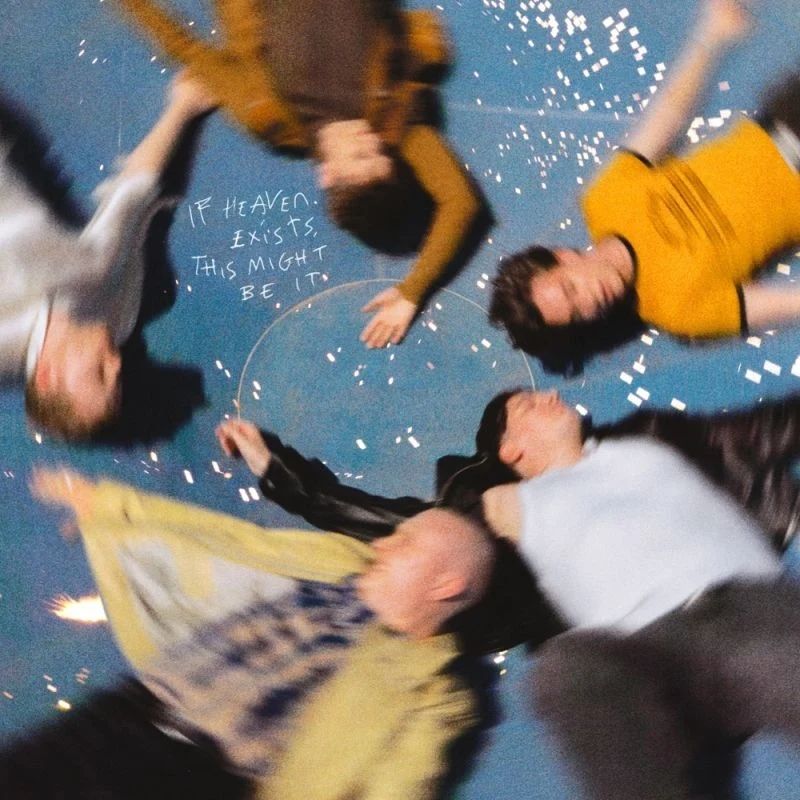
The album is the result of an intensive creative process that took the band to the UK. The band members themselves describe its creation as one of the most difficult and intense periods in their band’s history. The result is a 12-track album that, following their successful 2024 predecessor How Have You Been?, now ushers in a new era for the band.
From the very beginning, opener ‘The Better Life’ makes an impressive musical statement. Filled with layered vocal harmonies and an almost theatrical arrangement, the opening track evokes the monumental sound of classic rock productions. This creates an almost dystopian atmosphere that lends the song a particular intensity. At the same time, its musical power contrasts distinctly with its dark subject matter. The track tells of the longing to escape everyday life and flee into a supposedly better existence. However, it quickly becomes clear that this is an illusion. After all, those who constantly numb themselves and run away from their own reality risk missing out on life itself. The ominous atmosphere continues in ‘Blood on the Dashboard.’ Initially restrained piano notes give way to a distinctive, pulsing beat that lends the song an almost menacing intensity. While its predecessor primarily deals with the individual’s escape from reality, the focus now shifts further outward. Themes such as hatred, social tensions, hostility, and increasing polarisation come to the forefront.
Rather than getting lost in this heaviness, the album takes a considerably more uplifting turn with ‘Slow Dance (For a Minute).’ Rhythmic, catchy, and carried by a warm feeling of nostalgia, the track encourages listeners to dance and sing along. It is likely to reach its full potential in a live setting. Here, one of the album’s greatest strengths comes into play: the clear contrast between lyrical transience and musical lightness. A similar tension appears in ‘Baby, Please,’ whose playful, dynamic sound and bouncy rhythm make it instantly catchy.
Things become noticeably quieter and more intimate with ‘The Big Night Out.’ Rather than relying on grand musical gestures, the song impresses through restraint and emotional depth. ‘Parachute‘ is another of the album’s more tender moments. Combining delicate acoustic guitar with a warm, heartfelt atmosphere, the song tells of a connection that offers security and support even during the darkest of times. The stripped-back instrumentation lends the track a particular authenticity, creating goosebump-inducing moments, especially when performed live.
With ‘Want It Back,’ the album once again shifts direction, bringing the band’s familiar indie-rock roots back to the forefront. Driving rhythms, powerful guitars, and an catchy energy give the song an almost liberating feel. Meanwhile, nostalgia remains ever-present in its lyrics. Not everything that was once beautiful necessarily belongs in the present. ‘The Future Is Cancelled’ shows how difficult this realisation can be, progressing with a gentle, reflective sound and an underlying sense of melancholy.
A particularly interesting shift follows with the instrumental ‘If Heaven Exists (ft. Conic Rose).’ The mystical interlude, whose atmospheric soundscapes occasionally evoke associations with bands like The 1975, feels like a deliberate moment of pause. Rather than telling a story, the track inspires reflection.
This makes the placement of the following track, ‘The Waves (ft. Solann),’ all the more intriguing, as it stands out as one of the album’s highlights. Hypnotic, mysterious, and almost trance-like, it unfolds into a soundscape that comes across as both captivating and slightly unsettling. Electronic elements and the combination of English and French vocals give the track a distinctive character. With ‘The Waves (ft. Solann’ in particular, Giant Rooks demonstrate just how much creative potential they possess when they push beyond the boundaries of their established sound. Overall, the album impresses with its emotional diversity, even if not every musical moment is equally surprising. This doesn’t diminish its quality; it highlights what the band can do when it embraces its more experimental side.
With ‘Everything We Need Is Right Here’, the album takes a more hopeful turn. Upbeat, nostalgic, and full of joy, the song conveys a sense of lightness and inner peace. Its message is simple but meaningful: Sometimes everything we need to be happy is already right in front of us, without perfect circumstances or an elaborate plan. This also brings the album full circle. While ‘The Better Life’ tells of the restless search for a better life and the desire to escape one’s own reality, ‘Everything We Need Is Right Here’ seems to offer the answer, bringing a feeling of inner peace.
The album’s emotional conclusion comes with ‘Notes to A Younger Self,’ which feels like its great moment of realisation. Dreamy synthesisers and harmonies give the song an almost weightless atmosphere. The track feels somewhat like the closing credits of a film whose story has ended, yet whose thoughts and emotions linger long afterwards. Lyrically, the focus now turns entirely inward, toward a younger version of oneself. Something encouraging and hopeful about it, a sense of reconciliation with the past: rather than ending in overwhelming euphoria, the album closes with a feeling of acceptance.
One key element behind the emotional impact of Giant Rooks’ songs is Fred Rabe’s unmistakable voice. His vocals are instantly recognisable and have always been one of the band’s defining characteristics. On IF HEAVEN EXISTS, THIS MIGHT BE IT, he once again impressively demonstrates his range. Adding to this is the deliberate use of choirs, which lends the music additional dynamism and emotional richness. Another aspect that has made Giant Rooks particularly impressive for years is their international sound. The five musicians from Germany have developed a musical identity that melds naturally into the international indie scene without sacrificing authenticity or individuality. Given their musical ambition and continuous artistic development, the band’s international success therefore seems only natural. IF HEAVEN EXISTS, THIS MIGHT BE IT once again reinforces this impression, proving to be a successful and highly recommendable album.
Written by: Vanessa Svejkovsky
Edited by: Marloes Joosen